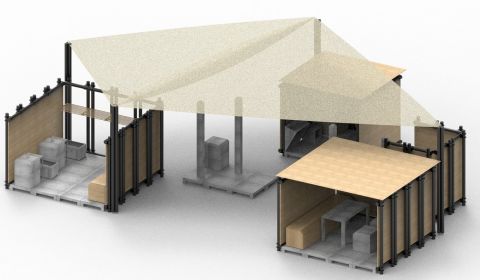
Using recycled concrete, local wood and galvanized steel, Nexus is robust, attractive and easy to deploy. Assembled without foundations or electricity, its modules offer shade, rest, hygiene and drinking water thanks to simple mechanisms. Nexus is the result of a multi-disciplinary and participatory design workshop involving local public authorities, urban planners and designers. In a context of transitional urbanism, it is easy to install and maintain and can be adapted to various emergency or transitional contexts. It can also be made available to inhabitants, offering them greater comfort in public spaces. Nexus has been developed and tested via an iterative process.
- Climate and environment | Housing | Urban
- Code: 15TK252572
- Jacques Delors building, JDE 60
Speaker
Practical information
- When
-
Wed 15/10/2025, 17:30 - 18:00 CET
- Where
- Jacques Delors building, JDE 60
- Type of partnership
- Partnership
- Format
- EURegionsTalk
- Theme
-
Cities building tomorrow
- Language
- English
Partner

Lyon Metropole
Reporting
Session summary
ERASME is a unique innovation lab. It helps Lyon Metropole to innovate in a variety of ways. The lab assists local authorities from the design stage through to the creation of innovative projects. To do this, it runs workshops and has a physical laboratory for testing and experimenting with innovative solutions. Various projects have been developed thanks to this lab, such as a map created by this AI to help the city green its territory.
NEXUS is one of the projects developed by ERASME. The conceptualisation of the project emerged during a workshop. The goal is to produce modular street furniture for all types of populations. The initial premise focused on global warming and its impact on vulnerable populations. Indeed, the Lyon metropolitan area will be especially affected by heat waves, which will have a particularly severe impact on homeless people. Access to water is one of the main problems associated with heat waves. Nexus is therefore a prototype of modular street furniture that can be permanent and adaptable in public spaces, but also quickly deployed in the event of a crisis (heat wave, flood, mass arrival of immigrants). The module provides access to drinking water for drinking, washing, and cooling off, but also offers a friendly space to rest or interact with other people using the module. The goal is to produce furniture that is technically robust, durable, attractive, and resistant.
The modular system must also be easy to repair, develop, and use by anyone. It encourages the involvement of local populations in production and the use of local materials, and additional guides are provided to assist with implementation and governance.
Quotes
-
Taking care of people also means caring for dignity — through form, space, materials, texture and light. Because aesthetics matter, not just function.