Cohesion and competitiveness are two sides of the same coin. One cannot exist without the other. Last years, regions have been confronted to the need to adapt to the twin transition while trying not to undermine the competitiveness of key sectors. Under the Work Programme of the Catalan Presidency and its leitmotiv “The Compass Motors: the contribution of the regions to the debate on the future economic and social model of Europe”, this session will showcase how cohesion policy, strategic autonomy and reindustrialisation are implemented by four leading regions, and how their transformation paths contribute to the EU’s goals on innovation, sustainability and long-term competitiveness.
Coordinator's website
To register for an EURegionsWeek close to you session, you will need to go to the Coordinator's website. The EURegionsWeek organisers do not process any participant data for these sessions, and are not responsible for their content.
- Climate and environment | Cohesion | EU/ European | Industry, entrepreneurship and SMEs (enterprise/ startup/ business) | Local and regional | Research and Innovation | Sustainable
- Code: Side253644
- Rue de la Loi 227, Brussels, Belgium
Practical information
- When
-
Wed 15/10/2025, 17:00 - 18:30 CET
- Where
- Rue de la Loi 227, Brussels, Belgium
- Type of partnership
- EURegionsWeek close to you
- Format
- Side
- Theme
-
Cohesion and Growth for the Future
- Language
- English
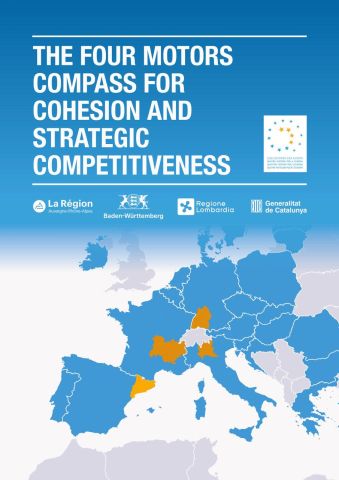
Partners

Lombardy Region

Baden-Wurttemberg Land
Auvergne-Rhône-Alpes Region
Document
side-event-15-oct-4me
Reporting
Session summary
The side event “Cohesion and Competitiveness as the Compass for Europe’s Future” took place on 15 October 2025 in Brussels, within the framework of the European Week of Regions and Cities (EWRC).
Organised under the Catalan Presidency of the Four Motors for Europe (4ME), the debate brought together high-level representatives from the four partner regions — Catalonia, Baden-Württemberg, Auvergne-Rhône-Alpes and Lombardy — alongside Enrico Letta, President of the Jacques Delors Institute and former Prime Minister of Italy.
Conceived as a high-level political dialogue, the session combined institutional interventions, analytical insights and regional perspectives, building on the exchange that had taken place earlier in Milan under the 4ME Presidency.
Following opening remarks by Minister Jaume Duch, Mr Letta delivered a keynote speech setting out the main challenges for Europe’s competitiveness and cohesion.
The debate then unfolded across four thematic blocks — Cohesion & the Single Market, Innovation & the Fifth Freedom, Decarbonisation to Compete, and Towards an Inclusive Economy — each introduced by one of the Four Motors’ regional representatives, followed by Mr Letta’s reflections and an open exchange among participants.
The discussion addressed core issues such as the future of the MFF 2028–2034, the role of innovation and research, the energy transition and interconnections, and the need for an inclusive European economy.
The event concluded with closing remarks by Minister Duch, who summarised the key political takeaways and reaffirmed the Four Motors’ shared commitment to a cohesive, competitive and forward-looking Europe.
Key takeaway: Europe’s competitiveness cannot be achieved without cohesion. A reformed MFF — complemented by instruments such as SAFE and sustained investment in innovation, services and housing — is essential to ensure a balanced and resilient Union.
Key takeaway: The Fifth Freedom should become the backbone of a renewed Single Market — integrating knowledge, research, education and data to drive Europe’s competitiveness, cohesion and global relevance.
Key takeaway: Energy interconnections are the backbone of Europe’s green competitiveness. Without a genuine Energy Union integrating hydrogen, renewables and regional innovation, Europe risks remaining fragmented, dependent and less competitive on the global stage.
Key takeaway: Europe needs leadership and vision to make inclusive competitiveness a reality. Beyond redistribution, inclusion must be built through investment, connectivity and effective multilevel governance. Only with new financial tools and a renewed sense of purpose — a true European moonshot — can Europe bridge the gap between ambition and delivery.
Quotes
-
• Europe must combine competitiveness and cohesion, innovation and solidarity.
• Warned against a false dichotomy between cohesion and competitiveness, stressing that both must advance together to preserve Europe’s unity and legitimacy.
• Emphasised that regional voices must be heard in the next MFF and in future EU research instruments, since many innovation-related competences lie at regional level.
how Europe can better integrate regional actors into energy governance and the design of future hydrogen ecosystems.
• Welcomed the notion of inclusive competitiveness, going beyond a redistributive vision of cohesion policy to foster equal opportunities, innovation and shared prosperity
“how to do more rather than less"
Additional links
https://exteriors.gencat.cat/ca/actualitat/251015-Quatre-Motors-Letta