The DeremCo project is demonstrating how post-use fiber-reinforced plastics, previously considered waste, can be transformed into valuable resources for new products, strengthening both sustainability and industrial competitiveness. By connecting regions with different capacities and experiences and developing innovative circular value chains, DeremCo is showing how it is possible to reduce environmental impact, open up new business opportunities, and support the creation of resilient communities. The event will bring together voices from industry, research, and authorities to discuss pathways for scaling up circular value chains, from technological innovation to policy recommendations.
Webstreaming
Coordinator's website
Coordinator's website
To register for an EURegionsWeek close to you session, you will need to go to the Coordinator's website. The EURegionsWeek organisers do not process any participant data for these sessions, and are not responsible for their content.
- Circular economy | EU/ European | Governance and Public administration | Industry, entrepreneurship and SMEs (enterprise/ startup/ business) | International | Research and Innovation | Sustainable
- Code: 28Side253675
- Via Cristoforo Colombo, 212, Rome, Italy
Practical information
- When
-
Fri 28/11/2025, 10:30 - 13:00 CET
- Where
- Via Cristoforo Colombo, 212, Rome, Italy
- Type of partnership
- EURegionsWeek close to you
- Format
- Side
- Theme
-
Cohesion and Growth for the Future
- Language
- English
Partners
DeremCo
Document
deremco-flyer
Reporting
Session summary
DeremCo Institutional Event in Rome Strengthens Policy Dialogue on Circular Value Chains for Composite Materials
28 November 2025 – Rome, Italy
On 28 November 2025, the DeremCo consortium convened an Institutional Event at the Lazio Region headquarters in Rome, bringing together representatives from national and regional authorities, the European Innovation Council and SMEs Executive Agency (EISMEA), industry players, research institutions, and companies involved in the project’s demonstration activities and Open Calls. The event aimed to foster a strategic dialogue on the regulatory, industrial, and policy conditions needed to scale circular solutions for fiber-reinforced composite materials across Europe.
About the DeremCo Project
DeremCo – De- and Remanufacturing for Circular Economy Investments in the Composite Industry is an EU co-funded project, under the Interregional Innovation Investments (I3) instrument of the European Regional Development Fund (ERDF).
It brings together 29 partners: research institutions, industries, and innovation hubs from Austria, Belgium, Finland, Italy, Portugal, Slovenia, and Spain, and is coordinated by the Department of Mechanical Engineering at Politecnico di Milano.
DeremCo tackles the challenge of regenerating post-use composite materials such as glass fiber- or carbon fiber-reinforced plastics, which are widely used in strategic industries including wind energy, aerospace, maritime, automotive, and construction.
The primary goal of DeremCo is to develop a systemic, cross-sectoral circular economy solution, driven by market demand, industrial needs, and societal requirements. This initiative aims to enable the cost-effective reuse of composite materials and components in new high-value-added industrial products and solutions.
A Cross-Regional Effort to Enable Circular Innovation
Hosted by Regione Lazio and coordinated by Veltha in collaboration with Associazione Fabbrica Intelligente Lombardia (AFIL), Politecnico di Milano and Fondazione Politecnico di Milano, the Institutional Event provided an opportunity to present the project’s progress, highlight the role of regional ecosystems, and discuss how the I3 instrument strengthens interregional cooperation in line with EU objectives on the green transition, competitiveness, and industrial resilience.
Presentation of Project Achievements and Demonstration Cases
During the event, partners outlined the technical and organisational solutions developed within DeremCo to address the reuse of post-use composites. Presentations included:
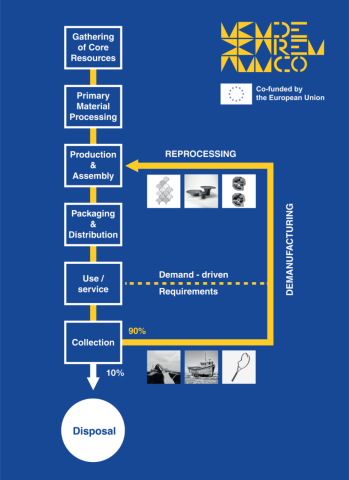
• An overview of the project’s cross-regional value chain model and its demand-driven approach.
• Demonstration of industrial cases applying recycled composite fractions in sectors such as textiles, automotive, construction, and design.
• Updates on the cascade-funded Open Call projects, which involve SMEs testing new applications of recycled composites in mobility and nautical waste valorization.
Demonstrators presented during the event showcased how recycled composite fractions can already be integrated into real industrial applications and creating new market opportunities.
Focus on Policy Alignment and Regulatory Enablers
A dedicated session was held on DeremCo’s policy-related activities, including the analysis of barriers and regulatory challenges affecting the reuse of composite materials in Europe. Key themes discussed included:
• The need for harmonized criteria for so-called End-of-Life materials across Member States.
• Barriers related to cross-border transport of secondary materials.
• The role of standardization, traceability and Digital Product Passport frameworks in supporting market uptake.
• The importance of multi-level governance to ensure coherent policy support for circular value chains.
Preliminary policy insights gathered through the project’s cross-regional dialogue will feed into DeremCo’s forthcoming recommendations to support regulatory alignment at regional, national, and EU levels.
Regional Engagement and Interregional Cooperation
The event highlighted the strategic relevance of interregional innovation initiatives for national and regional authorities. Representatives from institutions and from the DeremCo consortium discussed how cooperation across borders, facilitated by programmes like I3, can strengthen local ecosystems, stimulate innovation in SMEs, and prepare investment portfolios aligned with major EU industrial and environmental priorities.
Next Steps
DeremCo enters its final semester with ongoing activities to consolidate its demonstration results, develop new business models, finalize policy recommendations, and support the future deployment of circular solutions for composite materials. Outcomes from the Rome event will contribute to the finalization of the project’s strategic outputs and to continued collaboration with institutional stakeholders.
Quotes
-
“With 14 industrial demo-cases and 16 Open Call projects, companies are demonstrating that recycled composites can enter value chains, from automotive to design, through viable, specification-compliant processes. The challenge now is ensuring that the reg